Paqo, the Guardian of Pachamama / Mission and Vision
A paqo is a man of Kausay Puryi tradition, one who accepts that he lives in a world made of vital energy. He accepts that the mother of the world is Pachamama and the father of the world is Wiraqocha. A paqo is characterized by discretion, since he does not do anything to distinguish himself from others. He is one with everything.
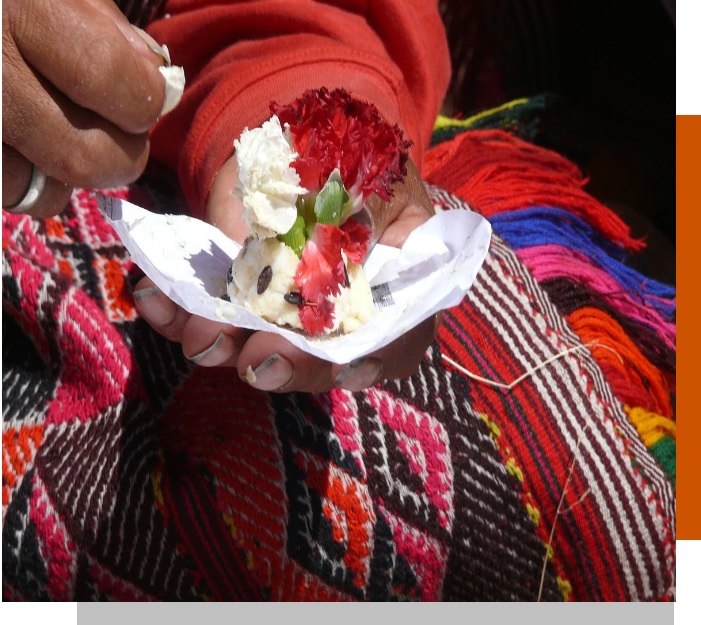
You recognize him by the misha he usually carries with him, though he doesn’t always let it be seen: it’s “the mark” (that’s what the word means) that he has encased in a cloth objects of personal power, creating a tool capable of healing, also a mean to communicate with the world.
A paqo is also a healer, and uses for this purpose the simplest tools: leaves from trees, stones or wood – tools of the Earth itself.
A paqo, as a child of Pachamama, respects the Earth, learns from the Earth, and creates upon the Earth. And as he knows the basic principle of ayni, he is aware of what one should, and what one should not do both to his person, as well as to his family, community and society. The spiritual art of Kausay Puryi and the paqos, as also happens with the martial arts of the East, is based on respect and – basically – on ayni, the law of reciprocity.
- When Oscar Nunez del Prado contacted the Q’eros, found that the legends had survived, and among them that the story of the Prophecy of the Andes, the Return of the Inca (Inkarri), had been kept alive.
A paqo knows about the Prophecy which according to the lineage masters has been activated in 2012, specifically on December 21st. This means that it is not a mythical legend, but an event that is framed both in the context of myth and history. The Prophecy is explained in detail in Elizabeth Jenkin’s book “The Return of the Inca”, and it refers to the meeting in specific sacred places in Peru, of the 12 people who will gather the complete human potential (intellect- yachay, emotional integration- munay, action- llankay ) to propel the collective field of humanity to the next higher stage. This global phenomenon happens at regular long periodic intervals of about 500 years, and the next seems to concern Peru.
For this reason a paqo can be defined as the Guardian of Pachamama, the one who has seen the mission, and recognizes it.
” … The message of the Andean Tradition is another language – it is the language of Prophecy. The provision comes through knowledge, through science. But emotions can predict something similar. When you project your feelings to the past, you produce mythology. When you project into the future, you produce Prophecy – not predictions. Our prophecy is regarding the arrival of the golden age, which will occur when the three children of God will perform ayni. The three children of God are the westerners (knowledge holders), the descendants of the dynasty of the Incas (holders of munay, emotions) and the third child is the common people of Peru (holders of action, llankay). The prophecy mentions that the moment you incorporate the three powers, then the golden age begins. Prophecy and prediction are two ways to see the future – one way is based on feelings and intuition, and the other is based on facts. Some believe that the prophecy does not apply, but there are others who believe that the provisions do not apply. There are people who pull anti-scientific movements, believing that science creates problems, saying that “we must get rid of our heads and return to our heart,” -you’ve heard this. We make a statement: there is no need to believe that. You need your emotions and you need your thoughts – carry your feelings and your thoughts with you, in order to develop correct actions.
The prophecy of the return of the Inca tells us that in the future, the holders of the three forces, the three children of God, will make ayni – they will join the three forces and will possess them all. So if you want to see that, the prophecy talks about the future and is about a person, a citizen of the future who will be the holder of knowledge, feelings and actions. So, only if you reach this level you will be able to observe what future requires. The top level of development of yachay (intellectual knowledge) is to think like a scientist – the top level development of munay (Love and will) is to be the holder of your munay, Love – the top level development of llankay (action) is to put your action under your power, being holder of your action. So each of the paths of the Andean Tradition, gives one of the pieces we need in order to become the citizens of the future “.
Juan Núñez del Prado